Today we're sharing a big milestone for Atmospheric AI: we've raised $10 million in seed funding and we also want to share our vision for a computational raw material world.
The people responsible for sourcing the materials that make up our world are making some of the most consequential decisions in manufacturing. Decisions that determine what things cost, where they're made, how resilient their supply chains are, and ultimately their impact on the planet.
And yet, they're often asked to make those decisions without being able to see or understand much of the industrial reality behind them.
When you buy a chemical, plastic or metal, you know what your supplier is quoting. You know what you paid last time. You might have a market index to compare it against.
But what about the refinery that made it? The feedstocks that went into it? The energy used to produce it? The other plants that could have supplied it? Or what happens to its cost and availability when something changes halfway around the world?
For the most part, that world has been incredibly difficult to understand.
Not because sourcing teams aren't sophisticated. Quite the opposite. They're extraordinarily capable people working with a fundamentally incomplete picture.
We started Atmospheric because we believed that could change.
Instead of asking suppliers for more information, we started with the physical reality of how materials are made.
Chemical engineering. Plant economics. Industrial processes. The relationships between raw materials, energy, production costs and emissions.
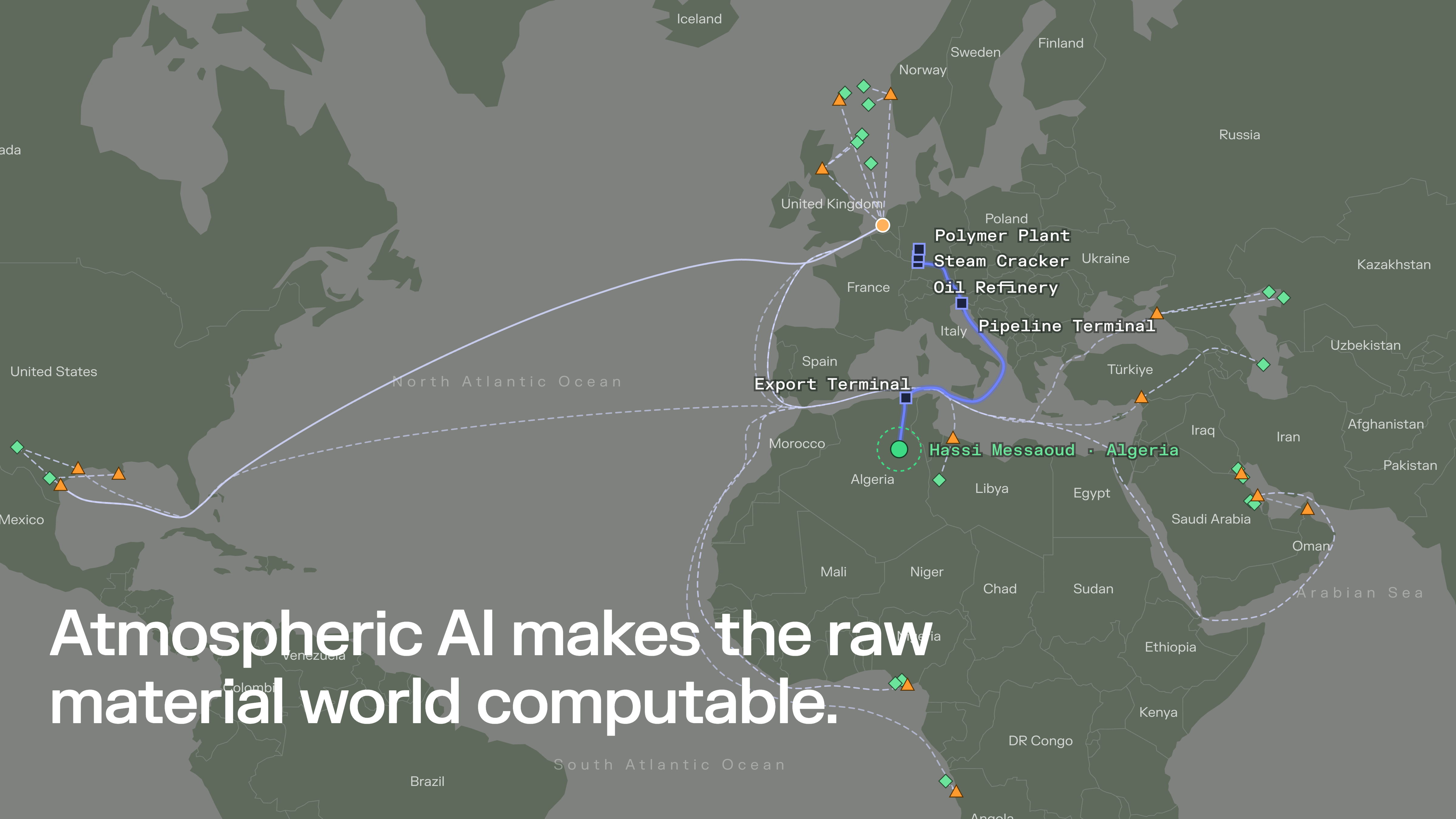
We've spent the last few years building computational models of those processes, and connecting them into a picture of the global industrial system — from oil fields and pipelines to refineries, chemical plants, terminals and shipping routes.
Today, Atmospheric runs around 50,000 facility models.
The exciting part isn't just that we can model how a material is produced. It's that we can use those models to help sourcing teams answer questions they previously couldn't.
What should this material cost? Is a supplier's price increase justified? Which other plants could make it? What happens if a particular route is disrupted? Could we make a different sourcing decision that's better on cost, carbon or resilience?
And we can do this without relying on suppliers sharing their internal operating data.
In one test, we reproduced a producer's published carbon footprint to within 4.4%, without using its own data.
For us, these aren't just interesting technical achievements. They're evidence that we can give people a fundamentally new capacity to understand the value chains they work with.
We've been fortunate to start working with some of the world's largest and most forward-thinking manufacturers, including Haleon.
One of the things we've learned is that the real value of Atmospheric isn't in showing someone a clever model. It's in helping an experienced sourcing professional make a decision they couldn't confidently make before.
Chris Low at Haleon puts it better than we can:
"For almost two years, Haleon has worked closely with Atmospheric AI to change how we source resins. We now start from what a material should cost, its carbon footprint and the risks in its supply chain, rather than from what a supplier quotes us."
— Chris Low, Head of Sustainability Procurement, Haleon
We've seen this play out in some extraordinary ways.
During the Hormuz disruption, one manufacturer was presented with a proposed price increase of $730 per tonne. Working through the underlying production economics, our team calculated that the actual increase in manufacturing costs was approximately $120 per tonne. That gave the customer's sourcing team a completely different starting point for the conversation with their supplier.
They didn't have to simply accept the proposed increase or argue against it without evidence. They could challenge it with a detailed understanding of what had actually changed.
We're not replacing the judgement and experience of sourcing professionals, but giving them the ability to see further, reason more deeply and act with greater confidence.
We're delighted to welcome DBL Partners as our lead investor.
DBL has a remarkable history of backing companies that bring new technologies into established industries, including early investments in Tesla and SpaceX. We're especially pleased to welcome Vinnie Caruso to our board.
As Vinnie explains:
"Manufacturers deeply understand their operations, but the industrial supply chains they depend on remain a black box. Atmospheric AI combines engineering expertise with AI to give manufacturers unprecedented visibility to make faster, smarter, and more sustainable sourcing decisions. That's exactly the kind of industry-changing innovation DBL Partners seeks to back."
— Vinnie Caruso, DBL Partners
We're also thrilled to welcome Dr Torsten Lichtenau as our Founding Chief Commercial Officer. Torsten joins us after 22 years at Bain & Company, where he was a Senior Partner and Global Head of Carbon Transition.
He brings an extraordinary understanding of the challenges facing industrial companies, and we're excited to have him helping us turn what we've built into something that can make a difference at scale.
And in September, we were honoured to receive the Early Stage award at the DPW Awards 2026 in Amsterdam.
These milestones mean a great deal to our team. But they're also a reminder of how much work we still have ahead of us.
So far, much of our work has focused on plastics. With this funding, we'll expand into more of the materials that underpin manufacturing, including chemicals, paper and metals.
We'll also deepen our collaboration with an initial group of around 100 leading manufacturers, learning from the decisions they face and building the capabilities that will make the greatest difference to them.
Our long-term ambition is much bigger than any one material or sourcing category.
As Roee, our co-founder and CEO, puts it:
"Our ambition is to build a computational model of the raw material economy. We want manufacturers to be able to understand the plants and supply networks behind everything they buy, and use that understanding to make better decisions. Chemical engineering gives us the foundation to do that. AI allows us to tackle it at a much larger scale."
— Roee Goldberg, Co-founder and CEO, Atmospheric AI
We believe that when people can understand the industrial world more deeply, they can make better decisions about how it operates.
That can mean better economics, more resilient supply chains, lower emissions, and entirely new possibilities for how materials are sourced and produced.
But none of that happens through technology alone.
It happens when people with deep experience, ambition and judgement have new capabilities at their disposal.
That's what we're here to build.
To our customers, investors, partners, advisors and the team that's brought us this far: thank you for believing in what we're doing, and for helping us make it real.
We're excited about what's next.
One question the world is asking, and the computed answer. Bi-weekly. Nothing else.
Subscribe



