A supplier asked for $728 a tonne on HDPE. Their facility's costs moved $118. Five-sixths of the ask has no cost underneath it.
Somewhere in your company's inbox this quarter is a letter that cannot be answered.
It arrived from a supplier, it cites unprecedented feedstock costs and an extraordinary market, and it asks for a number. It is polite, plausible, and completely unverifiable — which is the point. The buyer's options appear to be three: trust it, haggle blind, or escalate and hope. All three concede the same premise: that nobody outside the supplier can know what their costs actually did.
That premise had a good seventy-year run. It is now false, and one real letter shows what replaces it.
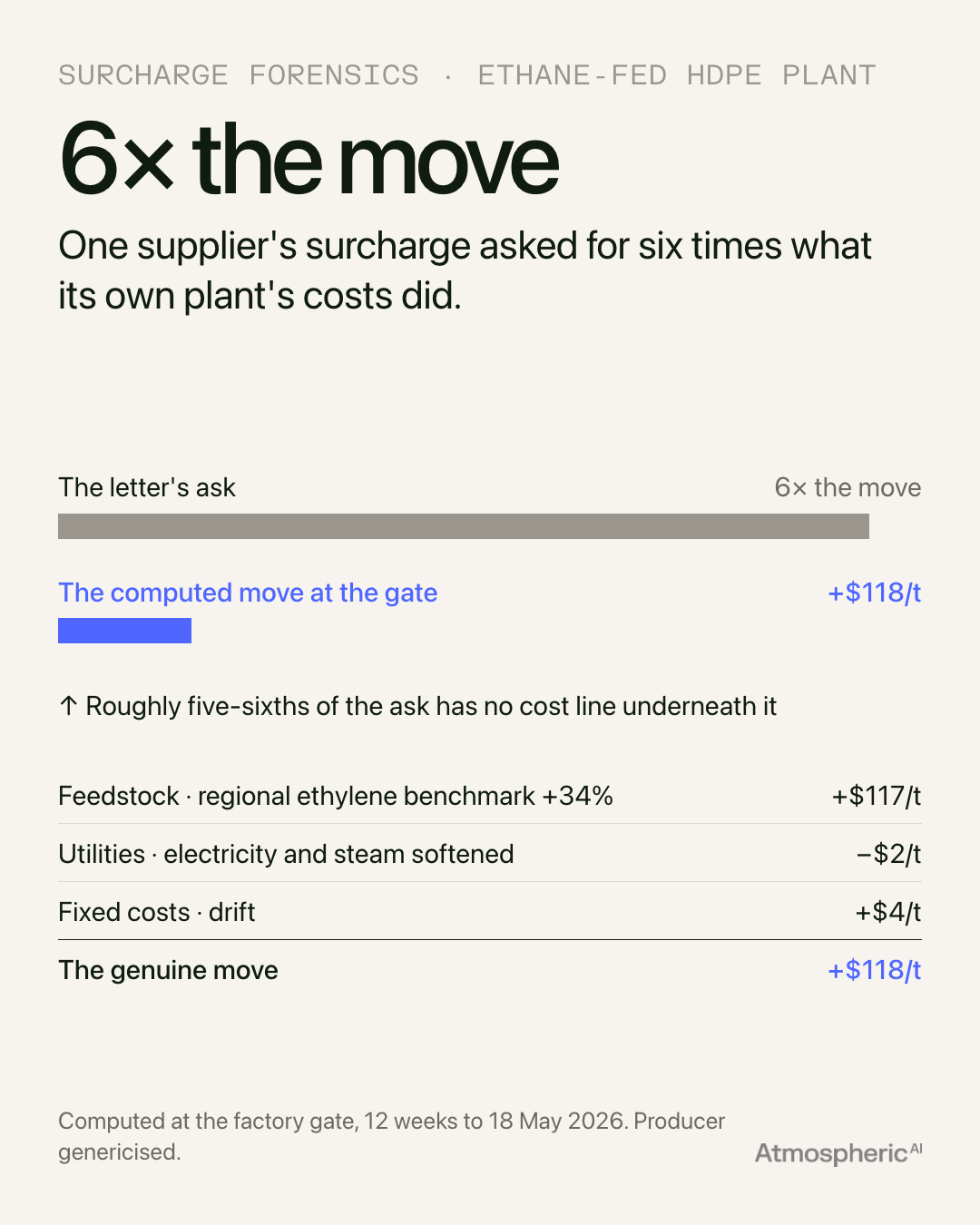
This spring, in the middle of the Hormuz repricing, a large North American polymer producer wrote to its customers with an increase on high-density polyethylene. The letter said what they all say — feedstock costs have risen — and asked for a number. We computed what that producer's facility costs had actually done across the same twelve weeks, at the factory gate, line by line. The ask was six times the move.
Here is the line-by-line. This is an ethane-fed plant — the mild end of this crisis, because its feedstock prices off natural gas, and gas never saw the strait:
Feedstock: up $117 a tonne. Real, visible, and defensible. The regional ethylene benchmark rose about 34% across the window; passed through at the plant's yield, that's $117 on a tonne of HDPE. This is the second-order ripple ethane plants caught — export pull and a tighter regional balance — not the naphtha cascade that hit Europe and Korea.
Utilities: down $2 a tonne. Not up — down. Electricity and steam softened over the same twelve weeks.
Fixed costs: up $4 a tonne. Drift, nothing more.
The genuine move: $118 a tonne.
Set that against the letter. Roughly five-sixths of the ask has no cost underneath it — no benchmark, no utility bill, no fixed-cost line that moved. The crisis explains about a sixth of the number on the page. The rest is something else: the market's fog, invoiced.
It's tempting to make this a story about one supplier's nerve, and that would miss the mechanism entirely. In an opaque market, the over-ask is rational — close to obligatory. The letter isn't priced against what the seller spent; it's priced against what the buyer can't see. Everyone writes some version of it, most buyers pay some fraction of it, and the fog itself sets the clearing price. A crisis doesn't create the behaviour; it creates the cover. The scandal was never the letter. The scandal is that for seventy years there was no instrument on the other side of it.
Because look what the instrument does to the conversation. The strong response to this letter is not "no." It's: "Yes to the $118 — effective immediately. Now show us which cost line moved by the remainder." Generous enough to be unarguable, specific enough to be checkable. The supplier's real increase is paid in full, on day one, without a fight — suppliers under genuine cost pressure deserve exactly that, and in this crisis some genuinely were under it: naphtha-fed producers saw genuine moves five times this size. But the burden of proof has changed hands. The seller is no longer negotiating against a buyer's scepticism, which is cheap to wear down; they're negotiating against their own facility's physics, which isn't. One computed number, and the letter that couldn't be answered becomes a letter that has to answer.
One honest caveat: a should-cost is a floor built from benchmarks, yields, and the facility's cost structure — it can miss contract particulars a supplier genuinely carries (inventory bought at the peak, take-or-pay clauses, hedges that went wrong). Which is precisely why the right response is a question rather than a refusal: if there's a real cost line behind the remainder, naming it should be easy.
And the same forensic runs in reverse. Crude has already given back most of the crisis move — by early July, Brent was back near where late February found it — and no letter will arrive announcing the decrease. Crisis surcharges retire quietly into next year's baseline unless someone can compute the way down as precisely as the way up was computed here. For a buyer, this is what the whole story reduces to: the difference between knowing that the market moved and knowing, to the dollar, what your number did.
Next time, a different question with a stranger answer: does cutting carbon have to cost money? The same five facilities say something surprising.
— Toby
One question the world is asking, and the computed answer. Bi-weekly. Nothing else.
Subscribe



