Everyone reports 25% of seaborne crude transits Hormuz. Almost nobody can say what share of their material does. So we computed it.
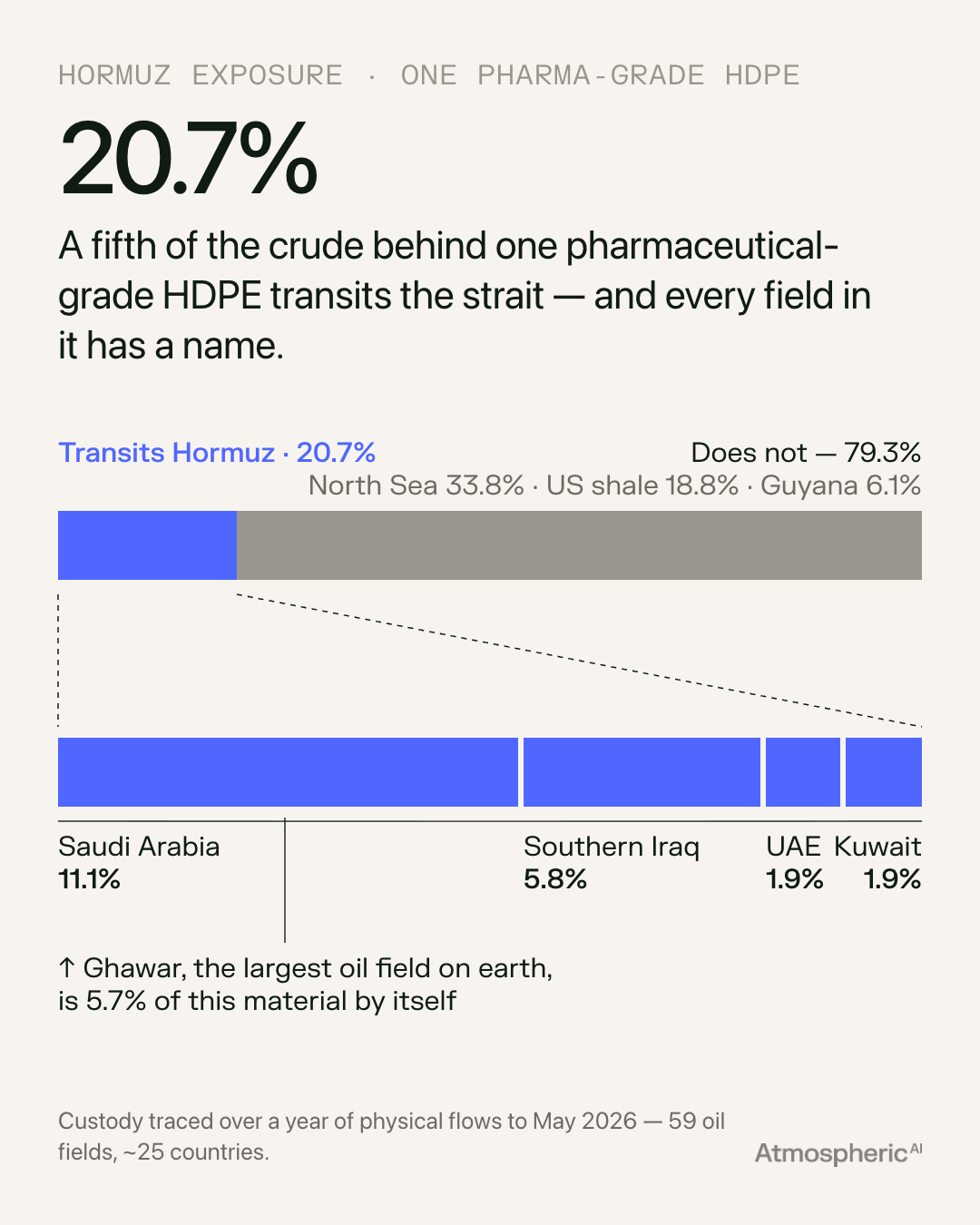
One tonne of pharmaceutical-grade HDPE — the polymer in a pill bottle — draws its crude oil from 59 oil fields in some 25 countries. This spring, a fifth of that crude sailed through the Strait of Hormuz.
When the strait closed, everyone reached for the same number: roughly a quarter of the world's seaborne crude passes through Hormuz. It's true. It's also nearly useless to anyone who has to act on it. If you buy polymers for a living, it doesn't tell you whether the material you depend on is 25% exposed, 50% exposed, or barely exposed at all. A global average is a fact about the world; it is not a fact about your supply chain.
The number that matters is specific: of the crude that ends up in my material, how much passes through that strait?And that number can't be looked up anywhere, because nobody publishes it. It has to be computed — by answering three questions in sequence:
Answering them means tracing physical custody backwards, step by step: from the polymer to the steam cracker that made its ethylene; from the cracker to the refineries that supplied the naphtha; from each refinery to the ports where its crude arrived; from each port back across the water to the terminal where the cargo loaded; and from that terminal to the field that produced it. Do this over a year of real flows and you get something no average can give you: the actual geography of one material's feedstock, with a probability attached to every path.
Here is what it looks like for one real material — an EU-manufactured, pharma-compliant HDPE grade we mapped this year. Its crude slate is genuinely global: about a third comes from the North Sea (Johan Sverdrup alone contributes 6%), nearly a fifth from US shale (the Permian and Eagle Ford), 6% from Guyana's Liza field, with West Africa, North Africa and the Caspian filling most of the rest.
And 20.7% of it loads inside the Gulf and sails through Hormuz. Saudi fields contribute 11.1% — Ghawar, the largest oil field on earth, is 5.7% by itself. Southern Iraq adds 5.8%, the UAE and Kuwait roughly 2% each.
So the useful answer for this grade is not "25%". It's 21% — with names attached. A fifth of the feedstock behind this polymer was exposed to the strait; four-fifths was not, and you can see exactly where the resilient four-fifths comes from. Two grades that trade at the same price can sit at opposite ends of that spectrum, and nothing on the datasheet or the invoice will tell you which one you own.
Two honest caveats. These are probabilistic inferences over a year of physical flows tracked real time as they transit the seas and pipelines of the material world. And this grade runs on the naphtha route, as most European polyethylene does; the same computation on a US ethane-route grade would return a Hormuz number near zero, which is rather the point.
Once the computation exists for one grade, it aggregates: the same question answered across every HDPE you buy, or a packaging range, or an entire bill of materials — one exposure number per material, summing to the only version of "Hormuz risk" that is actually yours.
What none of this tells you is what happens to price — exposure and price transmission are different questions, and the second has a stranger answer than the first. That's the next note.
— Toby
One question the world is asking, and the computed answer. Bi-weekly. Nothing else.
Subscribe



