Three words we hear every day. They mean the product is standard, the price is the price, and — the quiet assumption underneath — the cost of making it sits in a tight band, disciplined by competition. Is it true?
"It's a commodity." They mean the product is standard, the price is the price, and — the quiet assumption underneath — the cost of making it sits in a tight band, disciplined by competition. Nobody says the last part out loud. It is still the load-bearing part.
Except the commodity claim is really three stacked assumptions — same product, same properties, same economics — and only the first survives contact. The pellet looks identical; that much is true. But "HDPE" is not one polymer. It is a family name covering thousands of distinct grades — more than eleven thousand across the plants in our corpus — with different molecular architectures underneath: unimodal and bimodal, different densities, different melt behaviour, built by different processes for different jobs. A pipe grade and a pill-bottle grade share three letters and not much else, which is why switching supplier means months of requalification, not a purchase order. And the third assumption — that making it costs roughly the same everywhere — is the one we can now measure. It fails hardest of all.
So we measured it, like for like — holding the material constant and comparing plant against plant: production cost built from physics — the feedstock each facility actually eats, the energy it actually buys, the yields its process actually delivers — at every HDPE facility on earth whose supply chain we can trace from wellhead to factory gate. Just under a hundred facilities. A census of the traceable industry, not a sample.
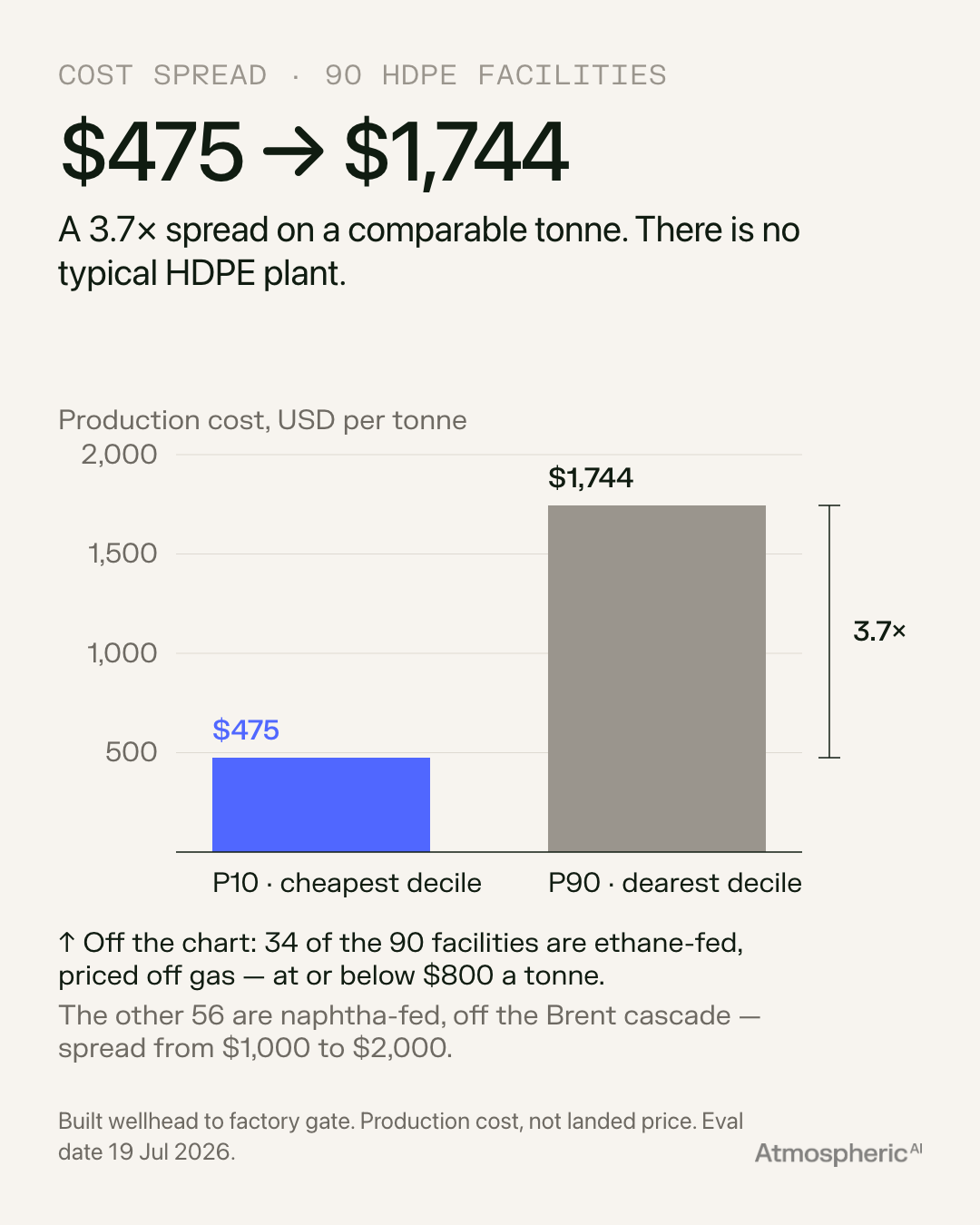
Between the 10th and 90th percentile, the cost of making a comparable tonne runs from $475 to $1,744. A 3.7× spread. At the extremes it is wider than five-to-one.
And the shape is stranger than the spread. Line the facilities up cheapest to dearest and the curve is not the bell you would expect of a disciplined commodity. It is bimodal: a third of the industry sits at or below roughly $800 a tonne; then a gap — almost nobody lives between $800 and $1,000; then the rest, spread across $1,000 to $2,000. There is no typical HDPE plant. There are two industries sharing one family name.
The two industries eat different molecules. One cracks ethane, priced off natural gas — the US Gulf Coast, Alberta, the Middle East — structurally decoupled from oil. The other cracks naphtha, priced off the Brent cascade — Europe and most of Asia. The pellet at the gate merely looks the same; the economy behind it is not even related. "Commodity" describes the pellet's appearance, and nothing else.
Now set the price system on top of the cost system, because this is where the word does real damage. HDPE prices do differ by region — but only by a factor of roughly one-and-a-half to two. A 3.7× cost spread underneath a ~1.5× price spread means the industry's margin is distributed with extreme unevenness: the bottom of the curve earns structural rents at any clearing price, while the top produces near or below its own economics, surviving on freight, tariffs, contracts and inertia. The market clears. It does not equalise.
You can watch the consequence in the news. The European cracker and polymer closures of the past two years are not a surprise to anyone holding this curve — they are its upper decile becoming untenable, roughly in order. A cost curve is the shutdown list in embryo.
For a buyer, the consequence is quieter and worth more. "The market price" is one number with a roughly $1,270 interior — a gap about the size of the median cost itself. Two suppliers quoting the same price can sit a thousand dollars apart in cost: one at a comfortable rent, one near its floor. Which one concedes in a negotiation, which one exits the business, which one is still there in five years — all of it is written on the curve, and none of it is written on the quote.
Three honest caveats. These are production costs at the factory gate, not landed prices — freight and tariffs compress the effective spread at the customer's dock, which is precisely how the top of the curve survives. Some of the spread is accounting-real rather than operations-real: a fully depreciated plant legitimately carries no capital charge. And a cost curve is not a price forecast — nobody sells below cash cost for long. The curve doesn't tell you what anyone will charge; it tells you who can't go lower.
So — are polymers just commodities? Not at any layer you test. The pellet merely looks standard. The polymer underneath is a family of thousands of grades that do not substitute for each other — which is why your qualification team exists. And the economics of making it were never uniform at all: a comparable tonne costs $475 in one place and $1,744 in another, and everything interesting in this industry — who profits, who closes, who concedes — lives in that gap.
The curve has one more axis, though. Compute carbon off the same physics, for the same facilities, and the industry's favourite trade-off comes out backwards. That's the next note.
— Toby
One question the world is asking, and the computed answer. Bi-weekly. Nothing else.
Subscribe



