Lower carbon costs more. The green premium, the abatement curve, the surcharge on the "sustainable" grade — the assumption is so settled nobody tests it. And sure, for experimental low-carbon technology — FOAK, sub-scale — it's true, often 10× true. But for the established, fossil-fed supply chains that make almost everything today?
Everyone prices the trade-off. Lower carbon costs more — that is the grammar of the whole conversation: the green premium, the abatement curve, the surcharge on the "sustainable" grade. The assumption is so settled it is rarely stated, let alone tested.
Clearly, when we talk about experimental low-carbon technology running FOAK, sub-scale units we expect costs to increase - often 10x. But when we look at established, existing fossil driven supply chains is “lower-carbon” more expensive?
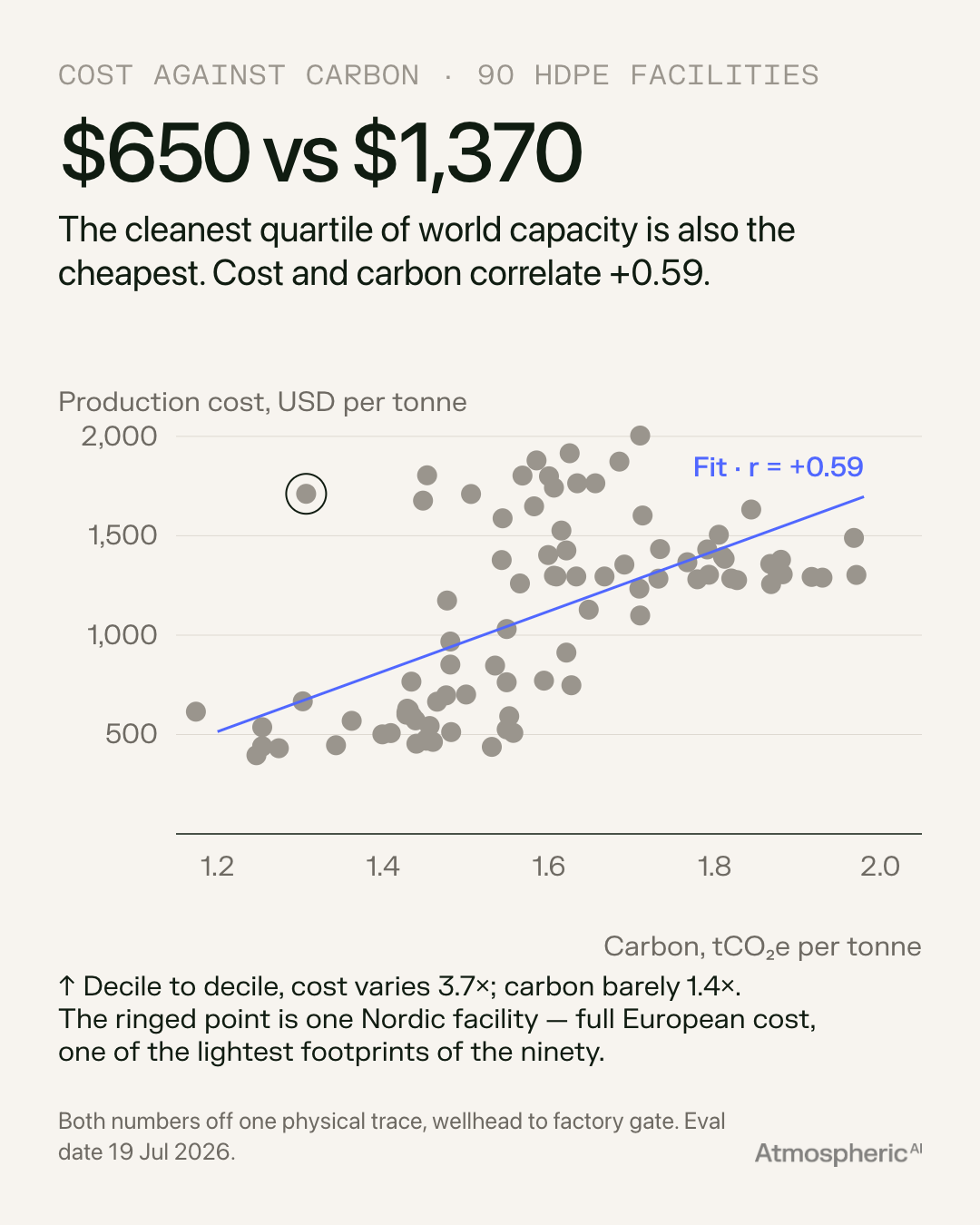
Well, we tested it, the only way it can actually be tested: cost and carbon computed off the same physics, for the same tonne, at the same facilities. Not a market price set against a database factor — one physical trace per facility, from wellhead to factory gate, producing both numbers at once: what the tonne costs to make, and what it emits being made. Just under a hundred HDPE facilities worldwide — a census of the traceable industry, not a sample.
The trade-off is not just absent. At the production layer, it runs the other way.
Across the census, cost and carbon are positively correlated — +0.59. Sort the world's capacity into quartiles by carbon footprint: the cleanest quartile produces at about $650 a tonne; the dirtiest at about $1,370. The low-carbon tonne is half the cost of the high-carbon tonne.
The mechanism is two physical facts: what the cracker eats and how efficient the units that transform feedstock are (whether this is oil > naphtha, naphtha > ethylene or ethylene > polyethylene).
Starting with feedstock: Ethane-fed plants — the US Gulf Coast, Alberta, the Middle East — buy feedstock priced off natural gas, structurally decoupled from oil, and carry a lighter upstream carbon path. Naphtha-fed plants — Europe, most of Asia — buy the Brent cascade and carry the heavier cradle. Cheap and clean are not competing objectives that some facilities heroically reconcile; they are co-determined by the same molecule. And it is not merely a regional artefact: within every region with enough facilities to test, the correlation stays positive.
What if we overlay unit efficiency, polymers are commodities right? Well, as per my last essay, I’m not sure I agree and one way of highlighting this is the fact we run 18 different archetype models for transforming ethylene into just HDPE. And another 80 or so to cover the other PE variants. These are bottom-up, physics models which look at the capital and thermodynamic efficiency of each licensed process and essentially “cost” it in terms of energy consumption, cost (in $ paid in that local industrial grid) and carbon (looking at local carbon efficiency). First point to note, there is a 30% variance in electricity consumption between process archetypes. Second point, there is a 7300% spread on grid carbon efficiency between Iceland at 18gCO2e/kWh and Turkmenistan at 1306.
Three honest caveats. These are production costs and production footprints at the factory gate — the market may still charge a green premium, which is rather the point: it is priced, not incurred. This is the installed fossil-route industry — the finding says nothing about bio-based or CCS routes, where genuine abatement costs exist and the trade-off is real. And these are probabilistic traces carrying model uncertainty; the facilities we cannot yet trace to the wellhead are excluded from the numbers, not averaged into them.
What survives the caveats is the sentence a buyer can use on Monday: the cleanest quartile of the world's HDPE capacity is also the cheapest — by about $700 a tonne. If a supplier quotes a premium for lower carbon, the physics is not what is being paid for.
Next week I’m going to dive into that 7300%….
— Toby
One question the world is asking, and the computed answer. Bi-weekly. Nothing else.
Subscribe



